Kilkenomics 2026
A fun weekend in Kilkenny spent steeped in discourse and debate.
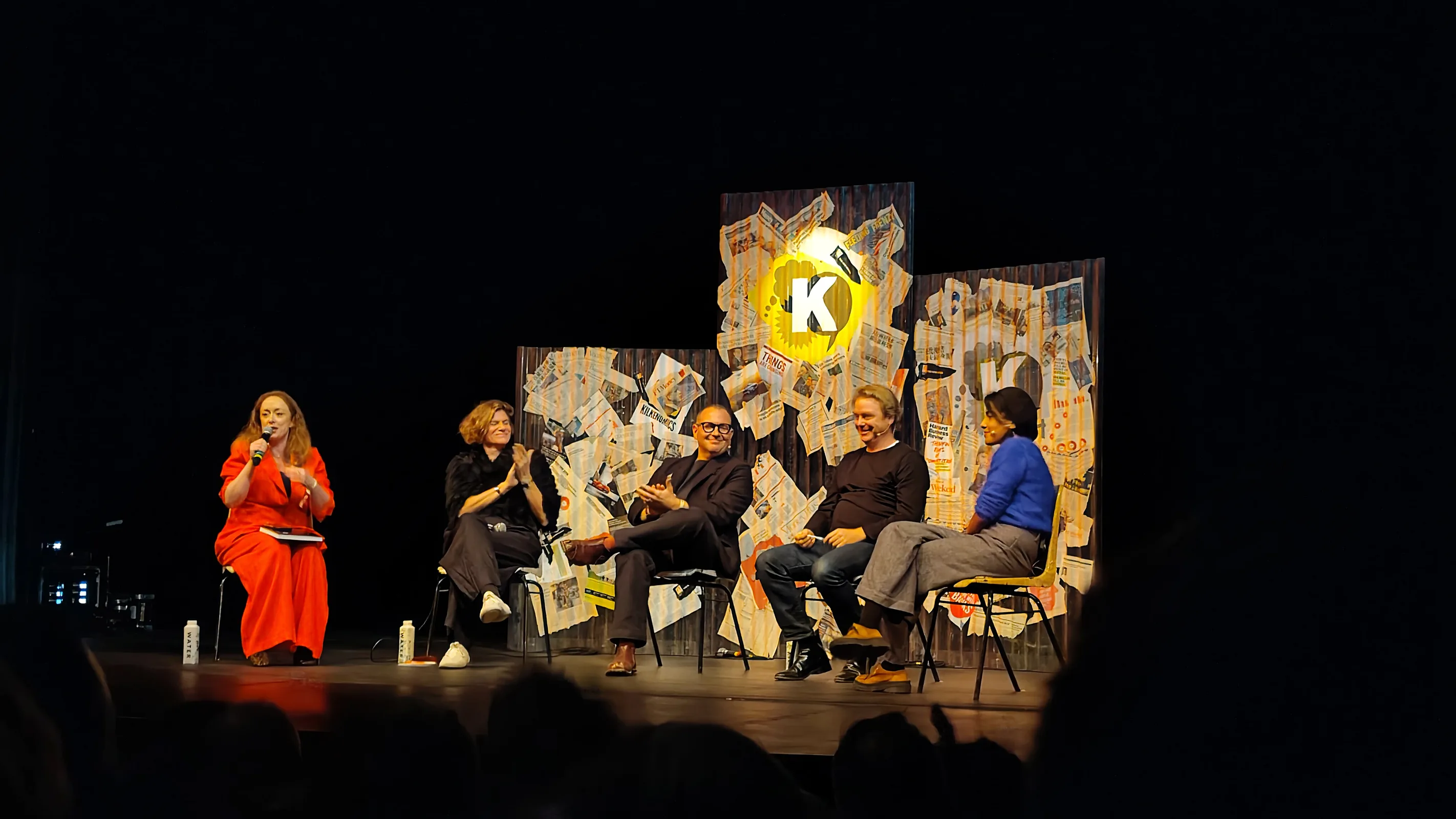
I went to Kilkenomics this year for the first time - I’ve been listening to David McWilliams’ podcast on and off for about eight years, since almost the very start. For those who don’t know him, he’s an economist and economics communicator, author and lecturer. During the later part of Boom 1.0 (1995-2008) he became known as a bit of a gadfly, a spoilsport naysayer who wouldn’t shut up in newspapers and on TV about debt, liquidity, over-financialisation and the inevitability of the bubble bursting. As we found out, he was correct, and while I’ve not always been as impressed by his grasp of fields outside of economics, I do appreciate someone with ambition, intellect and an open perspective elevating the discourse around Ireland, our future and how we can shape it.
Kilkenomics is his “Comedy and Economics Festival”, apparently the biggest economics festival in the world. I was finally tempted to make the trek, now that my kids are a bit older and leaving them for a weekend is merely a Big Ask of Nathalie, rather than literally impossible. I got to stay and hang out with my lovely mate Mark who I haven’t seen in a few years, sitting up late talking about movies, art and the state of the world. And I also got to see three talks by an intellectual hero of mine, Cory Doctorow1.
McWilliams has taken a right turn lately, which I am uneasy about, but in fairness to him, the one talk I saw him in he had placed himself on a panel with three intellectual heavyweights that would not be aligned with his positions on US power, immigration and tax policy, and it resulted in some lively debate!
This whole weekend was also taking place during an interesting moment, both in the wake of the beautiful Blue Tsunami sweeping the US (go, Blexas!), but also the plummeting tech stocks on Friday, that are either the start of a bubble bursting, or just a brutal but ephemeral correction.
Oh great, AI again
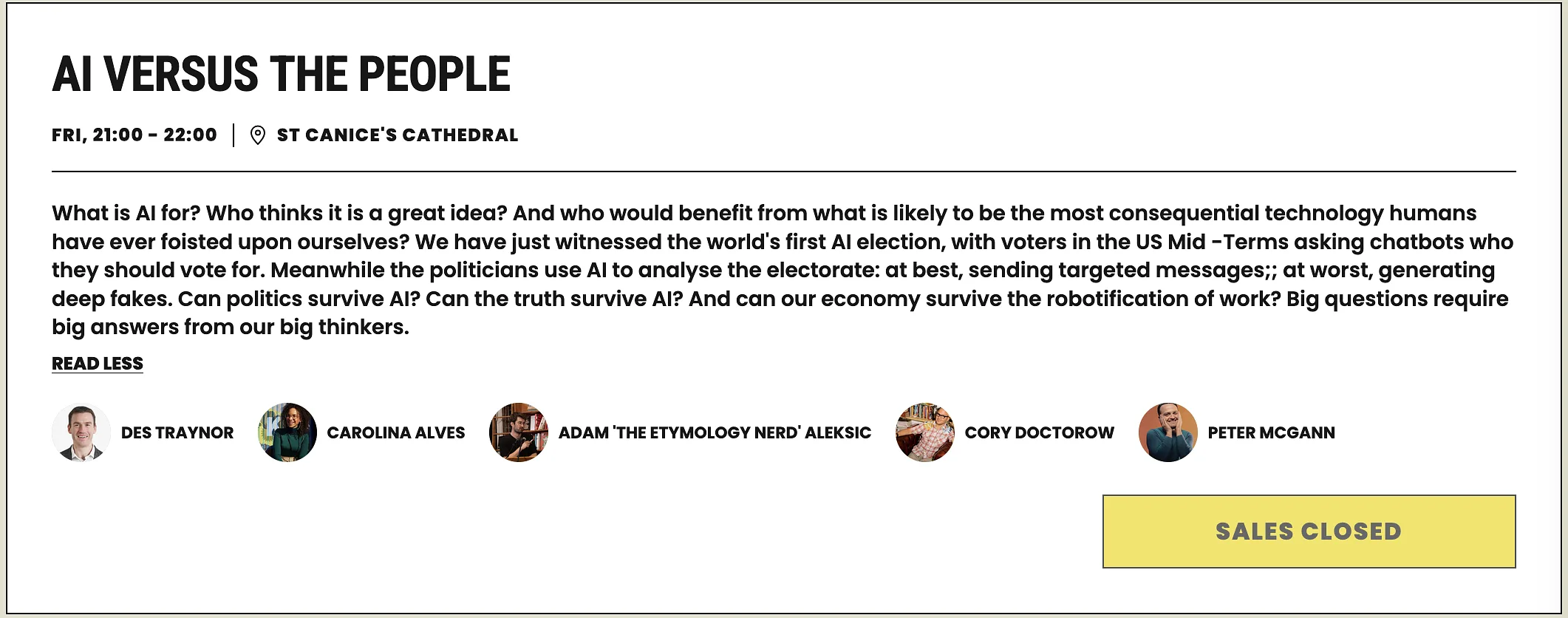 Sadly Carolina Alves couldn’t attend the talk. I’m not familiar with her work, but her profile suggests she would have brought a less West-focused perspective. Even so, the panel was super lively. I respect that Des agreed to be on the panel as the only entirely uncritical2 AI advocate. Each of the panelists gave their introductions with their take on AI. Des was delighted to announce that he had just sold his AI-centric startup for $3.6bn and that he’s a huge fan of the technology. Cory’s position on AI is well-documented (you can just buy his book), so given the current context his précis focused on the unfathomable financial recklessness of the industry.
I’ll be honest, I was keen to see these two clash3. I feel entirely aligned with Cory’s nuanced position on AI, which is neither uncritical or purist, and while I cheer on the success of people who make something from nothing, Intercom pivoted when AI arrived from a real company that made things to a gambit to convince other people to fire their CS departments, and then exited.
 Two things surprised me right away. One was Des’ face while Cory was describing how entirely impractical the current deployment of AI is. He looked like
a dog listening to Mozart someone was describing how to roll a square wheel. The second was that when the intros were over, he struck first and just had to jump at this idea that AI was anything other than a dynamite idea.
I will give Des credit for being alone on that panel, though of course he didn’t really land any counter-arguments that made sense. Hearing someone with an Irish accent parrot CEO-podcast-brained nonsense was honestly disappointing, but it was deeply satisfying to hear his takes on neoliberal hyper-individualised solutions dismantled as “Carbon-Footprint” bullshit designed to defuse motivation for systemic remedies.
The moment I will remember most was when they circled back to this deeply stupid idea that AI is going to permanently reshape society because so many of our jobs are “AI-Addressable”, meaning they have so little inherent purpose that a chatbot on a loop can do it just as well. Des opened with this, nobody bit, and he made sure to bring it up again at the end. His point was that people, especially Irish people, aren’t worried enough about this, and that as a society we need to reckon with it as a real problem.
Now, I hate this shit. We have real problems like climate change, a housing crisis, violence against women, rising authoritarianism, deepening wealth inequality. These problems hurt real people every day. AI taking over jobs is dumb, and a distraction. It’s jingling keys so we shut up and wring our hands about how powerless we are at the hands of these masters of the universe. It’s also validating Fin née Intercom’s business model.
This was easily rebuffed as nonsense, which of course Des did not seem to enjoy, so he tried to turn the conversation to a Techno-optimism angle, a more subtley toxic psy-op. He countered that a positive side effect to the radical redrawing of the class map would be lowering costs. OK, maybe most teachers are out of a job, but now everybody can access a one-to-one tutor on anything imaginable. When the unreliability of the chatbots was cited, Des, exasperated, threw up his hands and said “Isn’t something that’s right 90% of the time better than nothing?” and Cory, calm, but visibly angry, said “That sounds like poor education, for poor people,” which landed in the room like a slap. When Des repeated “but isn’t that better than nothing?” Cory responded, “I’d like to think we can all aim a bit higher than that.” Amen.
A couple of talks I didn’t get to, were one by Ronan Lyons about the housing crisis. I’ve heard him speak a few times and he’s able to punch through the fatalistic soporific lethargy that seems to grip anybody trying to solve that problem. The other was Reimagining Ireland’s Economy, trying to build a vision for what our future might look like.
-
They say you should never meet your heroes, but I bumped into Cory when I was getting some food with a couple of friends and he couldn’t have been nicer. ↩︎
-
I do not count “this technology is really powerful and we need to figure out how to organise society around it succeeding” critihype as criticism btw. ↩︎
-
Adam Aleksic was also fun and had some good points to make, though I wasn’t familiar with his work. ↩︎