Sexism and feminism in gaming
If you don't think there's anything wrong with the gender balance in gaming, then you are insane, but read this anyway, it might change your loopy doopy mind.
I have never called myself a feminist – I think feminism is great, but I also think wearing that badge takes more than seeing that women and men are equal, it takes an activist.
Today I read a brilliant article by Brenna Hillier over on VG247, an enraged and articulate rant about how infuriating it is for large modern games to continue to omit playable female characters. During a live stream by Capcom of their new game Deep Down, the developer revealed that there would be no option to create a female character, and they defended the move for undisclosed story reasons. Let's be clear, whatever those reasons are, they are self-imposed since they created the story in-house.
Off the top of my head, the only remotely legitimate reasons for this inflexibility I can think of is that your character gets changed into a woman at some point, or that the story is somehow about the unique experience of being a man, both of which are solvable with some relatively cheap narrative rewiring.
Bechdel
Before I go any further, this brings me to the Bechdel test used as a critical tool for film; if you're unfamiliar, it goes like this:
- It has to have at least two (preferably named) women in it,
- who talk to each other,
- about something besides a man.
It sounds easy, right? Try to think of a list of films you love that pass all three criteria.
Trainspotting, Magnolia, Fight Club, Dumb and Dumber, Schlinder's List, The Lego Movie etc.
It's surprisingly and disappointingly difficult. I don't think every film needs to pass the Bechdel test. For example, Fight Club is a film about masculinity. It treats its small number of female characters with respect, but it's a film about men and there's nothing wrong with that. The test is more useful as a measure of media-wide representation than a statement on any particular film.
I mention this as a point of contrast between games and other media like movies. The Bechdel test breaks down when used with games since there's agency and the potential for non-linear narratives, so a game may pass or fail the test based on how it's played, but it's still worth examining the industry in the spirit of the test, and it quickly becomes clear that the ratio of games that pass and games that fail is horribly out of balance.
All of that said, I do think that it is possible for a game, a patricular type of game, to present a male-only perspective. Jason Rohrer received criticism last year for his game The Castle Doctrine, where you play as a version of him, with no other option. In the alpha you were protecting his children and wife, all passive agents. This was rectified in a couple of updates where the wife character received mechanical depth (a shotgun and a wage), and Rohrer defended his decision to make his protagonist male only. I was happy to defend the decision until I heard his defence. It was a little too dismissive and clueless, but his attitude aside, I think there's a difference between a conscious decision by a single author or tiny team of authors making something very personal, and a large company creating media for the masses, and Capcom fall largely into the latter category.
The Bioware Approach
Filmmakers have to make a choice – should their main character be male or female? It's a static medium, so with rare exceptions, each character must be one or the other, and the existence of feminism doesn't denigrate or invalidate the presence and quality of male-led films. This isn't a zero-sum game. The film industry has a terrible record when examined with the Bechdel test, but even the male-led films can be accessible to a female audience. It's very frustrating not to see more female-led movies, but personally I don't find it really gets in the way when you sit down to watch a film. It would have been nice to see more female characters in The Avengers, but that didn't stop me enjoying it, and I'd imagine that most people felt the same way.
Computer games, however, don't have to make a choice for you, and I can definitely see it being consistently annoying to get excited about an awesome-looking game, only to discover that it has "not for you" written all over it in invisible ink.
Roleplaying games like the Mass Effect and Dragon Age series (from the progressive and excellent Bioware) have shown how you can simplify the process of making your character either female or male by opening the option tree to LGBT possibilities. For example, let's say you write a game story with inter-character relationships that look like this:
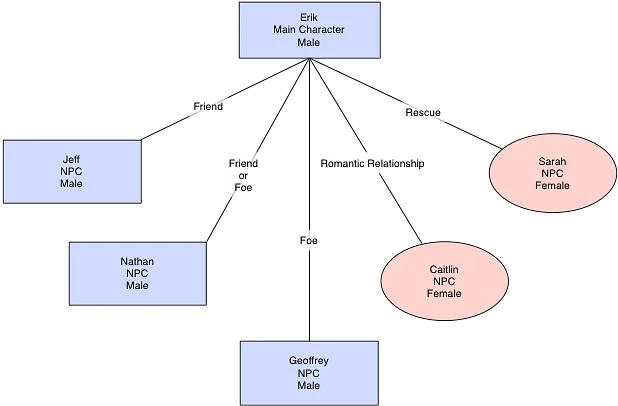
I only count one choice there, which means there are two different ways for that story to look. Either Erik is friends with Nathan, or they're enemies. You could look at creating a separate version of this map for a female main character:
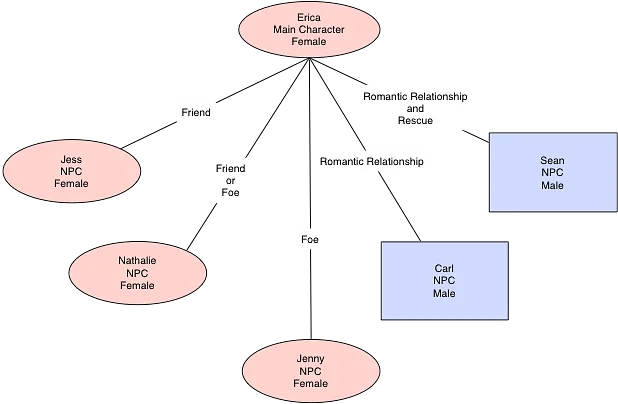
This is better, but there's a substantial cost with providing this option. You need to hire double the number of voice actors (if applicable), and you need to double the number of character models, which is undeniably costly. This is the most common defence of the absence of gender choice. Why spend all that money without really providing much extra choice? Bioware's approach, however, looks like this:
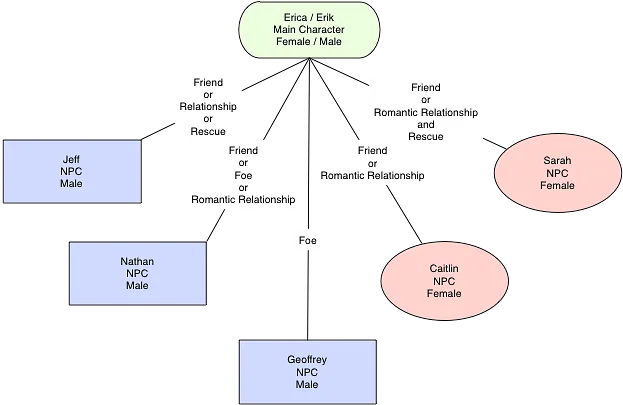
You need to create one extra model, record a handful of extra lines of dialogue for each actor, and suddenly you have a much more dynamic experience, that also opens your game to a larger audience. The circular argument that there's less ROI on creating female character models doesn't make any sense, since a market unprovided for can't grow. As Lesley says in her post linked to above:
"In most shooty-type games you go in and play as a big lumbering meathead of a dude, or you don’t play at all. I choose the latter."
The "Laziness" Accusation
And who could blame her? Games that shun the female market are doing themselves a great disservice, and they are shunning women and girls when they decide not to include female characters. Other media like books, film and television have the questionable excuse of being static at least, but games have every reason to include the option.
I have heard disappointed gamers call developers lazy for choosing not to include female characters, but I have a better word: apathetic. They just don't care about inclusion. They don't see why it's a problem and definitely don't feel like it's their problem to solve. I'm sorry to say that even as a man who tries to enlighten himself, I can honestly say that I have been part of the problem of sexism in society more often than I have been part of the solution, and worse, never on purpose.
Apathy is like entropy - it begets itself, and where you have mass-media producers like Capcom and Splash Damage (creators of Brink) perpetuating and validating this huge imbalance, you make it seem crazier and more unreasonable for it to be any other way, at least to those who get the long end of the stick.
The Subtle Knife
After reading Hiller's article, I noticed a prominent gaming journalist I follow on Twitter had also tweeted about it, and she seemed to be getting some hassle from a male gamer. I won't link to the conversation here because I don't want to give the griefer any more time or attention, but I was struck by his umbrage. He seemed appalled – appalled, I tell you – that the author would write such an angry article and then not allow comments underneath, but that was nothing to how appalled he was – appalled, mind – when he was spoken to as if he were being sexist. What's sexist about asking questions? What's sexist about wanting to discuss this calmly?
It struck me like an iron bar that every time someone speaks out about this issue, especially women, they get hit by a wave of this useless pedantic condescending bullshit which irritates and drains the intellect, and often insists ad nauseam that it is in no way sexist.
I'm reminded of the point made by the increasingly loveable Rory O'Neill (aka Panti Bliss) speaking about homophobia on The Saturday Night Show (emphasis mine):
“Oh listen, the problem is with the word ‘homophobic’, people imagine that if you say “Oh he’s a homophobe” that he’s a horrible monster who goes around beating up gays you know that’s not the way it is. Homophobia can be very subtle. I mean it’s like the way you know racism is very subtle. I would say that every single person in the world is racist to some extent because that’s how we order the world in our minds. We group people. You know it’s just how our minds work so that’s okay but you need to be aware of your tendency towards racism and work against it."
I saw that Polygon had a short news bit about the Deep Down announcement from Capcom, scrolled down to the comments, and saw the same calm, patronising tone being used against people complaining about the omission, saying it was unfair to call Capcom sexist when there was REAL sexism (and clearly unknowing, unironic racism) out there "i.e. Middle Eastern views of women". This also reminded me of Panti's beautiful Noble Call, when she said:
I have been lectured by heterosexual people about what homophobia is and who should be allowed identify it. Straight people - ministers, senators, lawyers, journalists - have lined up to tell me what homophobia is and what I am allowed to feel oppressed by. People who have never experienced homophobia in their lives, people who have never checked themselves at a pedestrian crossing, have told me that unless I am being thrown in prison or herded onto a cattle train, then it is not homophobia.
I don't think it's anybody's business to say (or cowardly imply) that a woman doesn't have the right to feel angry, disappointed, excluded or oppressed by content creators disregarding her experience, treating it as inferior or less worthwhile.
So I have never considered myself a feminist, until now. Seeing the subtle and stubborn streak of very real misogyny at work in the world, creating noisome dreck to shout down the voices of reason has made me realise that it's not enough anymore to sit back and hold an opinion. Games are a rapidly maturing medium, and we as consumers and creators have the power to shape that growth. Apathy is the enemy and if you're not with us, then why not?
Don't answer though, it's a rhetorical question. Just join us already and get on the right side of history.