Designing a Puzzle
A little bit more on how I approached designing the (admittedly, as yet unfinished) puzzle in my Twine game "I Try My Best".
Though this puzzle is still a work in progress, I thought I'd put up a few notes and the working diagram of what I have in mind.
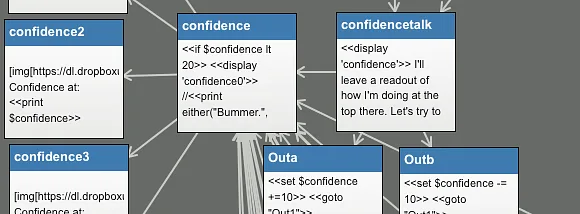
The idea is that the goal is to get to talk to the pretty girl on the couch. If it goes well, the game gets more interesting. If it goes poorly, you'll have another chance with another girl, but either way it opens up the rest of the house.

You can't talk to the girl on the couch when you walk in the door though, your confidence is too low to take on the big drunk bully chatting to her. The only option is to explore the room, and when you do you should hopefully see a causal chain start to emerge. How exactly that chain reads and works depends on some of the events leading up to this point.
At this point in the writing process at the Dublin Twine & Jam, I ran into a bit of a visualisation brick wall. Up until this point I'd been keeping all of the game's elements in my head, but it was starting to get a little bit dense. I had loaded my Twine project with macros and functions and had been expending a lot of energy on coding and comedy generation. A misstep in the puzzle could cost me a lot of work and time, so I remembered seeing an interesting-looking app called Scapple a few weeks ago and picked it up on a whim.
I used it to very quickly write up a rough map of the house and then draw out the causal link. Though I ran out of time, I would have loved to have used it on the day to draw in the secondary puzzles, or the alternative paths to solving that part of the story, and then of course, how the rest of the house opens up.
If you'd like to play the game or read more about it's development, head on over to I Try My Best in the My Games section of my blog.